
Searching Cases by Name
For a name search, Walker County records flow through the statewide re:SearchTX case search. The system covers courts that take part. Pick the party option under Search By. Type a first and last name, keeping it tight rather than broad. When a spelling looks shaky, use a wildcard. Put it at the end of the name to catch variants. Expect look-alike names in the results. Check the court, case type, filing date, and case number before you open any detail record on the docket.
- Identify whether the Walker County case belongs to a district court, County Court at Law, justice precinct, or Huntsville Municipal Court.
- Open re:SearchTX and choose the party search path, or browse the county Document Center if seeking a posted docket PDF.
- Enter the most exact known name. Add a trailing asterisk only when a broader match is needed.
- Review all plausible results and open case detail to compare parties, court, filings, and hearings.
- Confirm the match with the proper Walker County clerk before relying on it.
| Field Label | Type | Required | Notes |
|---|---|---|---|
| Cases/Hearings | Tab or control | Not stated | Changes the search context. |
| Search By | Dropdown | Not stated | Guide shows Party, Attorney, Case, and Judicial Officer paths. |
| Party name | Text | Not stated | A trailing * wildcard is supported. |
| Advanced | Control | Optional | Adds criteria tied to the selected search type. |
| Sort By | Control | Optional | Newest filed, oldest filed, or case number. |
Walker County Case Search Routing
A "Walker County case" is not one database. The records sit with different offices. District Clerk Leslie Woolley holds the files of the 12th and 278th Judicial District Courts. They cover felony, major civil, family, juvenile, and related district matters. County Clerk Kari French keeps County Court at Law misdemeanor, civil, probate, and guardianship files. Each justice precinct handles its own limited-jurisdiction cases. Huntsville Municipal Court holds city Class C matters.
Start with the court printed on your notice or pleading. For district questions, call (936) 436-4972 or email wcdc@co.walker.tx.us. County Clerk matters go to (936) 436-4922, and the County Court at Law line is (936) 436-4920. A JP case belongs with its named precinct. Huntsville municipal cases can be sorted out at (936) 291-5476. Get the routing right first, and you avoid the blank docket results that come from asking the wrong office.
Searching by Case Number
A full cause number usually beats a common name as a search key. In re:SearchTX, choose Search By Case. You can also simply give the number to the right clerk. Walker County examples include numeric district cause numbers alongside separate municipal docket or citation numbers. No single universal Walker County case-number pattern exists in the official material. Whatever you have, enter it exactly as printed, punctuation and leading zeros included.
A failed exact search usually means a spacing or punctuation slip. It could also be the wrong court. Confirm both before retrying. Never guess at a year or a case-type segment. Some citation numbers live in a JP or municipal workflow instead of the District Clerk system. The Texas citation and notice search takes a cause number, court or county, name, or status. It searches its narrower set of documents.
Walker County Case Search Controls
The official re:SearchTX guide documents both case and hearing searches. It also adds advanced criteria, sorting, export, saved folders, alerts, sharing, and document purchase. Walker County searchers get a statewide layer through that interface. The court where the case was filed still has the final word on the record. Public access may differ from what an attorney sees. The official statewide interface lays out those search options and settings.
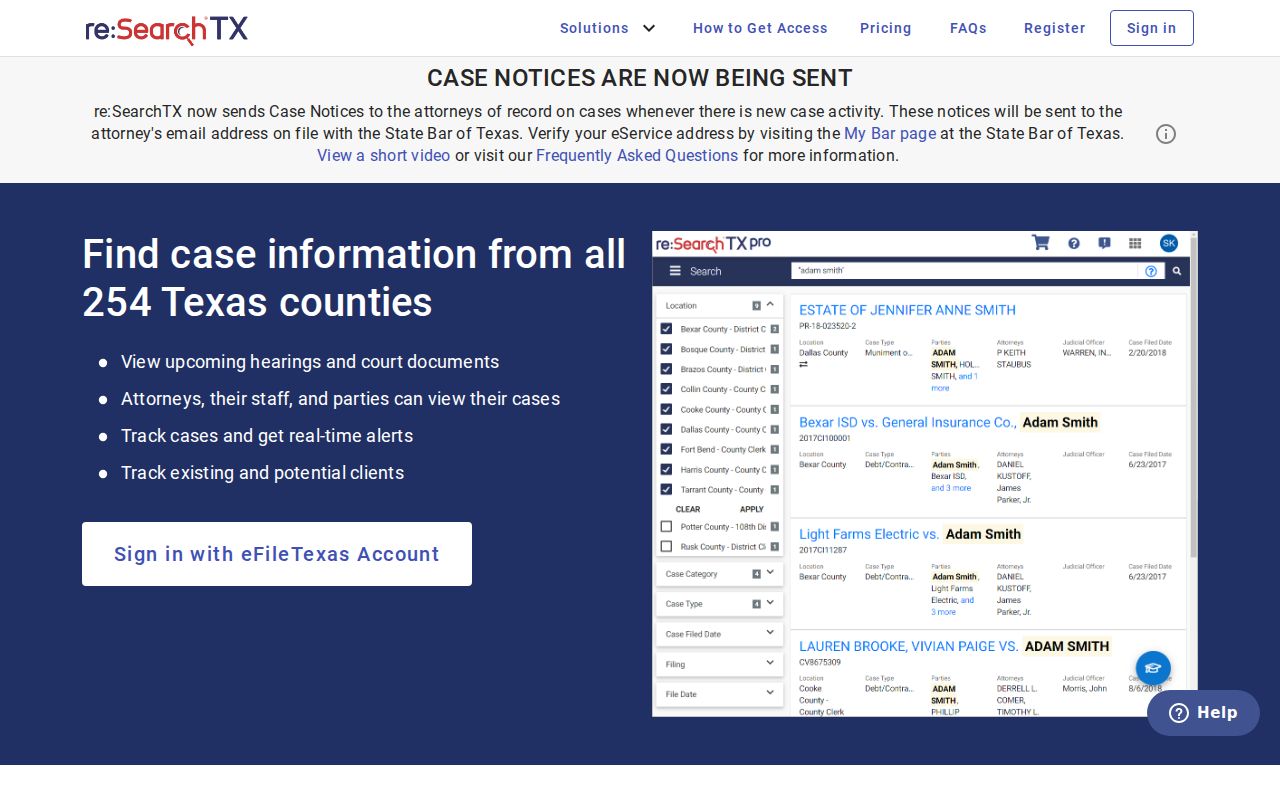
Cases and hearings live in separate search contexts. That distinction matters when you drill into results. Once a search returns rows, the controls let you sort them and export a copy. Case detail then carries the facts you need to confirm a true Walker County match.
Note: Search controls can change, so compare the current interface with the official guide before relying on a saved workflow.
What a Case Search Returns
A Walker County case search returns index-level facts, not the clerk's whole file. On re:SearchTX, a case detail page can list parties, attorneys, and judicial officers. Filings, documents, and hearings can appear too. The published Walker County docket PDFs work differently. They give you a calendar or status snapshot rather than a complete clickable filing history.
| Case Number | The court-assigned cause or docket identifier used to distinguish the matter. |
|---|---|
| Style / Parties | The case caption and public party roles, subject to redaction and access limits. |
| Case Type | A category such as criminal, civil, family, probate, tax, or municipal. |
| Filed Date | The filing date, which is not the next hearing date or alleged offense date. |
| Status | A label such as filed, open, closed, or disposed where supplied by the source. |
| Hearings / Filings | Event and filing entries available within that court's statewide coverage. |
Local sample rows can go further. They show charge, bond, jail days, counsel, setting count, or comments. Labels deserve care. "Filed" is not a finding of guilt. "Settled" is no substitute for a signed dismissal or judgment. When the outcome matters, pull the actual order from the clerk.
Walker County Case Search PDFs
Walker County runs two different online tools, and knowing which is which saves time. The Walker County Document Center is the first stop for many people. It holds published docket and calendar PDFs. You browse them by title, type, department, category, topic, year, and page. It is a reading room, not a live register of actions. So you can pull up a dated civil docket call or a criminal calendar. But you will not see every filing tied to the underlying case.
For a case lookup with more depth, the county backs a separate system. The Walker official-records search serves as that second channel. The official page it leads to shows what it covers in its own index of records.
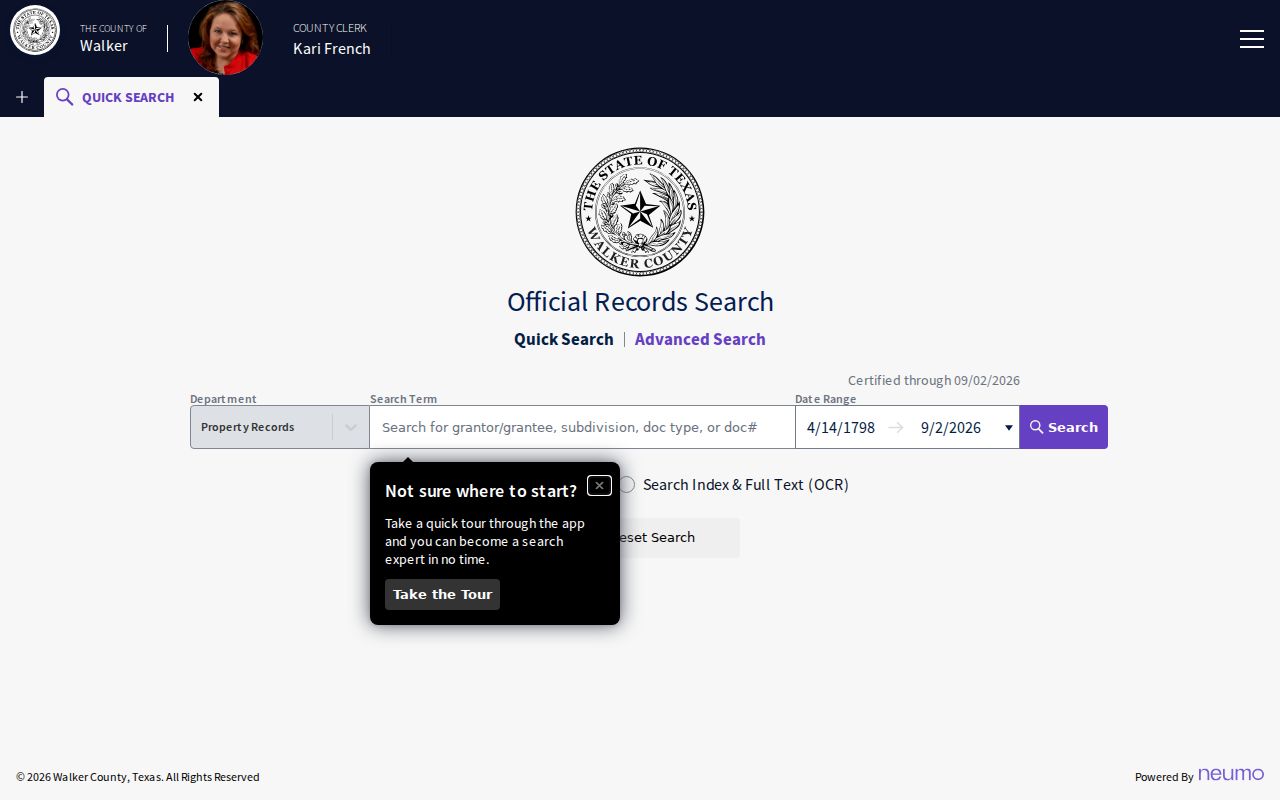
This system is built for official and property records, not lawsuits. Search fields cover grantor, grantee, subdivision, document date, and full text. It is not the standard Walker County case-search portal. Treat it as a land-records tool. Never read a blank result there as proof that a court case does not exist.
Statewide vs County Case Search
Statewide tools and county tools answer different questions about a court record. A broad re:SearchTX docket search pulls case data. It draws from participating courts all over Texas. Walker County's Document Center, by contrast, posts local PDF dockets for the county itself. Need the official case file or a certified copy? Go to the clerk for that court level. If one channel comes back thin, try the others before you give up.
| Feature | Statewide re:SearchTX | Walker County Channels |
|---|---|---|
| Coverage | Participating Texas cases, hearings, filings, and documents. | Posted PDFs plus separate district, county, JP, and municipal custody. |
| Best use | Statewide name, case, attorney, officer, or hearing search. | A known Walker case, local calendar, copy, or certification. |
| Depth | Case detail varies; some documents require purchase. | Docket PDFs are snapshots; clerk files hold the documents behind them. |
| Main limit | Criminal records are excluded from the collection described in the 2024 Judicial Council report. | No current universal interactive Walker portal was confirmed. |
An empty statewide criminal result does not prove a case never existed. The case may simply sit in a court that does not feed the state system. Check the District Clerk, the County Clerk, the Justice of the Peace, or the municipal court for the right court level.
Walker County Case Search Access
Members of the public can run a search without an attorney role. Pulling actual documents is another matter. That step can require an account or a purchase. Attorney-of-record access differs from what the general public gets. The official re:SearchTX access page spells out the route that fits your situation.
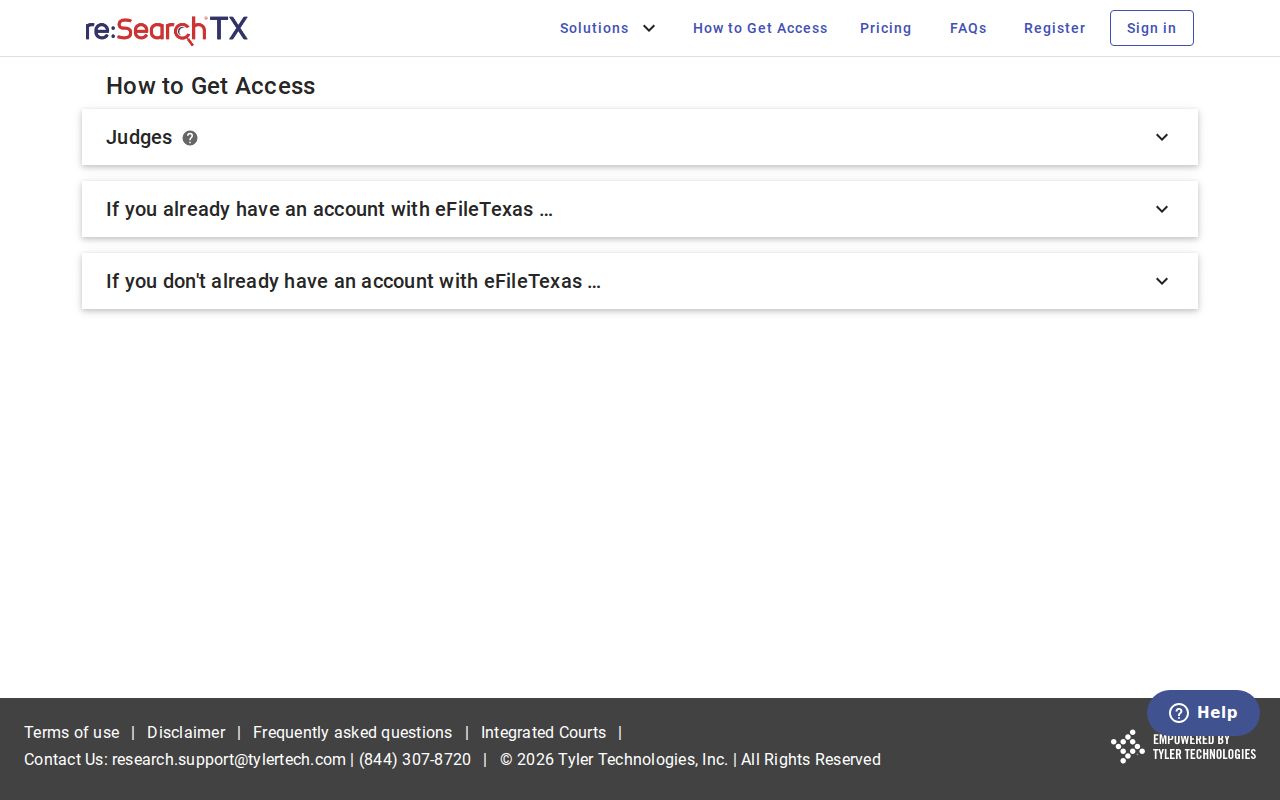
A result on screen is one thing. A filing you can actually download is another. Some Walker County documents simply are not public online. When that happens, ask the right clerk for a copy, whether electronic, printed, plain, or certified. Never try to get around a role check, a fee, a sealing order, or any other protected-record control.
You can still walk up to a counter at the Walker County courthouse. The state courts set no posted public-terminal policy. So call ahead. The District Clerk takes copy requests through the e-file copy-form workflow. The County Clerk accepts office or mail requests. Huntsville municipal records go by email, fax, in person, or mail. For certified copies, rely on the clerk, not the court coordinators, who handle settings.
Walker County Case Search Link
Need a document from a Walker County district court case? The District Clerk's copy request form asks you to print a case summary from the Walker Odyssey public portal. Check off the documents you want. Then e-file the whole request into the case. One caution applies. The old portal hostname has been unreliable, so the legacy web route may not load. That glitch says nothing about the underlying clerk record. The docket still exists at the courthouse even when the old address stalls.
If the link will not cooperate, go straight to the District Clerk by phone, email, fax, or at the counter. Include the cause number, the document title, the file date, your delivery preference, and whether you want a certified copy. Skip unofficial mirror sites entirely. Probate, guardianship, and County Court at Law files live with the County Clerk instead. A precise request keeps the two Walker County clerk systems from getting crossed.
Access and Restricted Cases
Just because a case is public does not mean everything in it shows. Texas law keeps juvenile records confidential under Texas Family Code section 58.007. Other things hide parts of a Walker County court docket too. Sealed court records qualify. So do expunction and nondisclosure matters, protective orders, and other statutes or court orders. Filings themselves must be scrubbed of sensitive data first, since Texas Rule of Civil Procedure 21c requires redaction.
Judicial records fall under Texas Rule of Judicial Administration 12. Case files answer to court rules, statutes, and clerk procedure. A docket row can appear in public view. Its documents may stay withheld or partially redacted. If the clerk denies you access, ask which rule or order controls. Then ask whether a redacted copy, an index entry, a certified disposition, or an authorized-access route is available.
Blank result: Check the court, spelling, cause number, statewide coverage, and clerk channel before concluding a Walker County case does not exist.
What matters in the end is a clean result: an accurate record of your own case, a court date you can trust, or a fair reading of a public matter. The clerk of the originating Walker County court remains the final source.